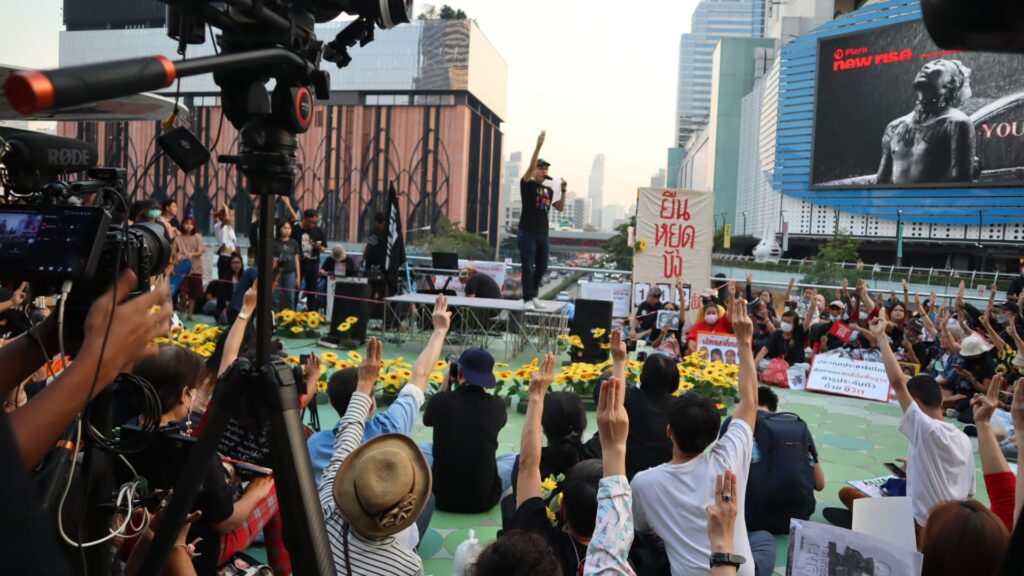
The Labor Movement for Democracy held an International Workers’ Day march, “MAY DAY 2025,” from Ratchaprasong Intersection to the plaza in front of the Bangkok Art and Culture Centre. The march advanced the idea that independent/freelance workers, delivery riders, service-sector employees, and outsourced contract workers are all workers and the state must provide equal protection for everyone. The movement also opposed the draft Independent Workers Bill (พ.ร.บ.แรงงานอิสระ), viewing it not as support but as an attempt to control and divide the workforce.
Labor scholars, for their part, pushed back against calls to bar migrant workers from political assembly in Thailand. They argued that the state and society should remain open, to demonstrate that the country does not practice discrimination, and that democratic advocacy should be normal and open to all.
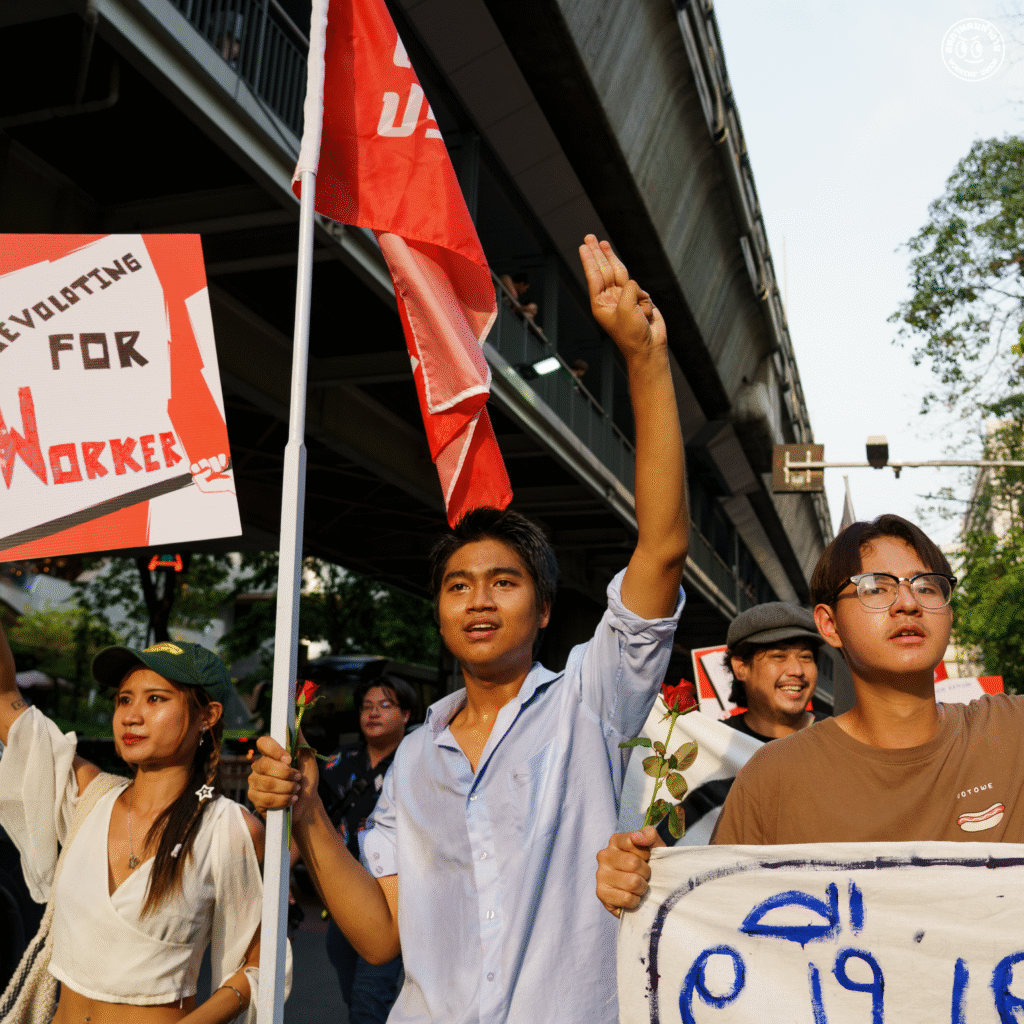
1 May 2025 — At 4:00 p.m. in front of CentralWorld at Ratchaprasong Intersection, people began gathering in response to a call by the Labor Movement for Democracy, which brought together diverse groups including the Workers’ Union group, delivery riders, service employees, Mokeluang Rimnam activists, housekeepers at the Government Lottery Office, migrant workers, and others. The crowd then marched from Ratchaprasong to the Bangkok Art and Culture Centre (BACC) at Pathumwan Intersection to celebrate International Workers’ Day, commonly known as “May Day 2025.”
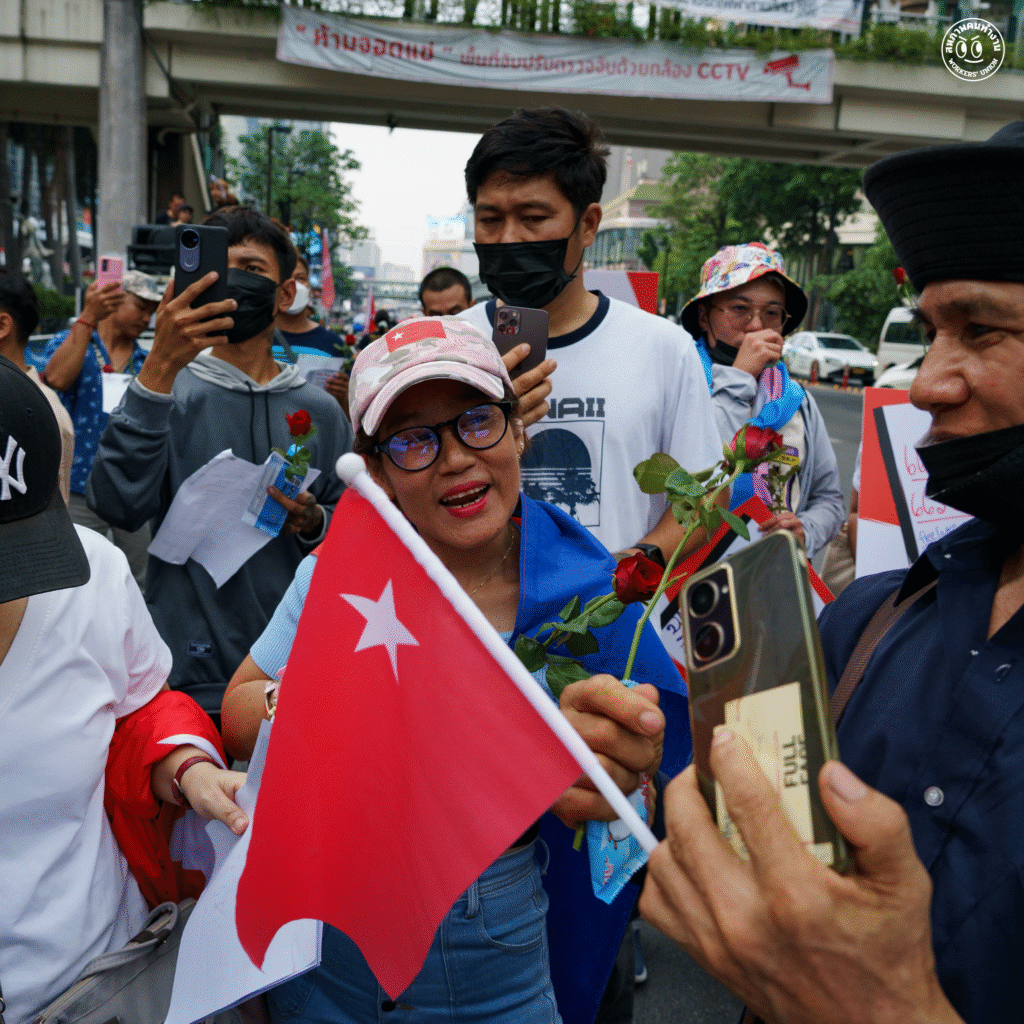
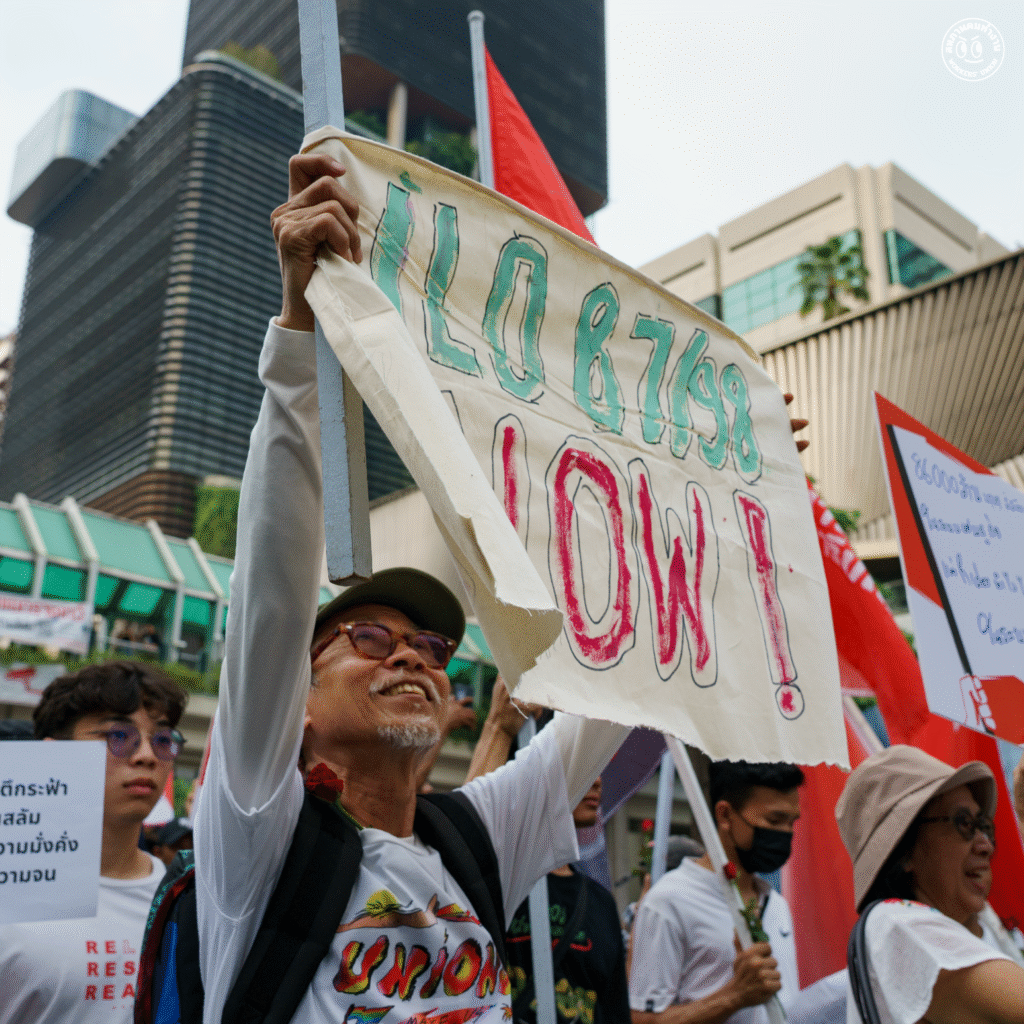
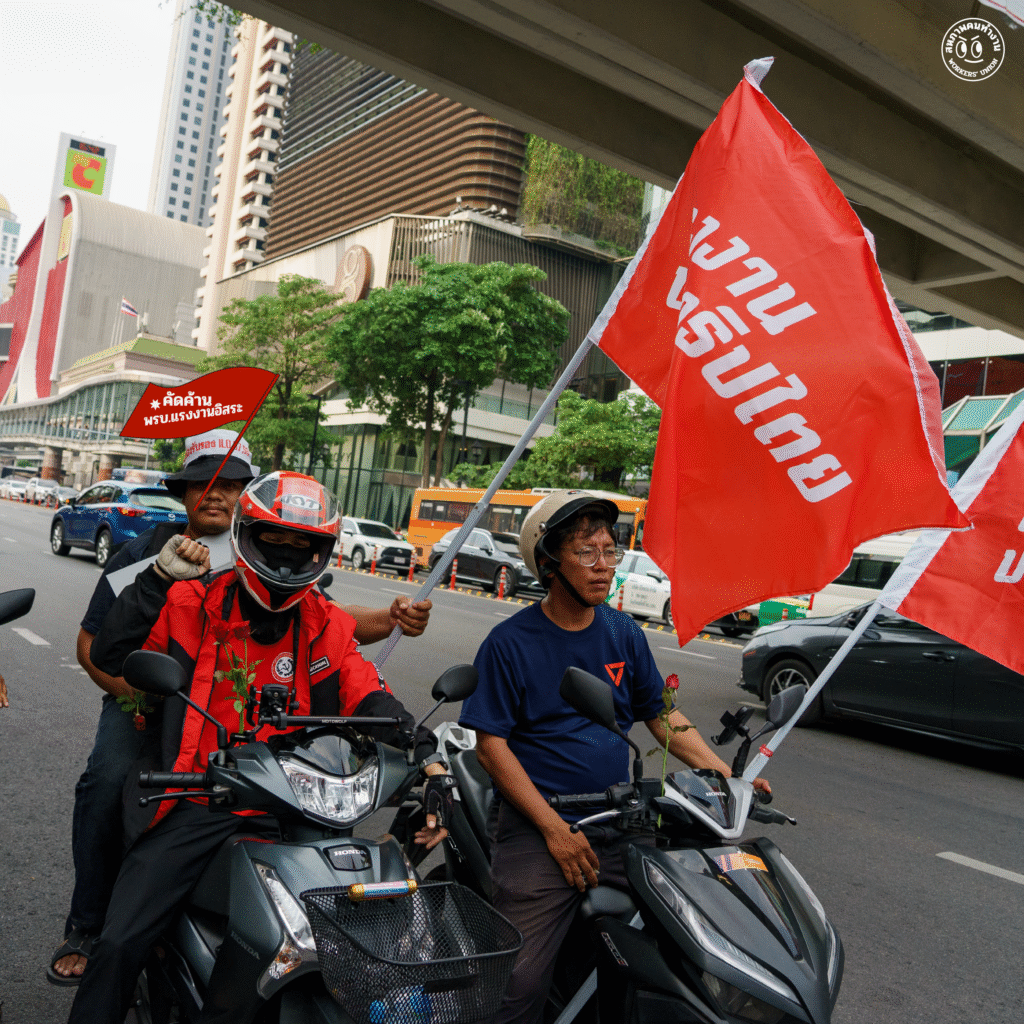
Around the same time, a group of migrant workers held a symbolic action against Myanmar’s military dictatorship and Senior General Min Aung Hlaing, commander-in-chief of the Myanmar armed forces and leader of the coup.
4:30 p.m. — The march formed up in front of the sound truck. Flags and placards were prepared with messages such as “We reach the destination but end up with only small change,” “CON for 99%,” and “Service work is work — Sex Work is Work,” among others.
About 4:35 p.m. — The procession set off toward Ratchaprasong Intersection.
For this year’s International Workers’ Day, the Labor Movement for Democracy highlighted its opposition to the Draft Act on the Promotion and Protection of Independent Workers (the “Independent Workers Bill”), which is currently awaiting submission to the Cabinet.
At present, the Labor Protection Act B.E. 2541 (1998) primarily protects employees under employment contracts. As a result, contract-for-service workers, platform workers, street vendors, agricultural workers, and others fall outside its labor-rights protections.
The Ministry of Labour later drafted the Independent Workers Bill, intending it to aid informal/outsider workers, but it has faced opposition from some labor scholars and labor-rights advocates.
For example, delivery riders and platform workers would be defined as “semi-independent workers.” Many fear that such a label would further divide workers, weaken their bargaining power, and could even exclude platform workers from standards set by labor law.
Another concern is the creation of a Committee to Promote and Protect Independent Workers to decide on employment disputes—e.g., unfair pay, dismissal without severance, etc. The 28-member board would comprise 16 government representatives, 4 from business, and 8 from labor, all appointed by the minister, not elected by the public—raising worries about state dominance.
Moreover, even if independent workers form their own organizations, they cannot bargain directly with employers; they must go through the above committee.
Health and accident protection is also unclear. The draft merely instructs the board to consult with relevant agencies, without setting binding protection standards in the law—unlike in some other countries.
For these reasons, opponents want the bill kept off the Cabinet agenda and instead propose extending the Labor Protection Act to cover all categories of workers.
That said, the bill is still only at the Cabinet stage. Even if it passes there, it would still need approval from the House of Representatives and the Senate before promulgation and enforcement.
5:06 p.m. — The march reached Wat Pathum Wanaram, where representatives laid flowers for six people who died during the armed dispersal of the Red Shirt protest in 2020 (B.E. 2563). Participants were asked to observe one minute of silence for the civilians and workers who died at the temple before continuing on to BACC, the day’s destination.
The six deceased were: สุวัน ศรีรักษา, อัฐชัย ชุมจันทร์, มงคล เข็มทอง, รพ สุขสถิตย์, กมนเกด อัคฮาด, and อัครเดช ขันแก้ว.
5:30 p.m. — The procession arrived at the BACC plaza.
“We want to return to the old work-permit renewal system for migrant workers.”
The May Day march was joined not only by Thai activists and workers but also by Myanmar migrants who have traveled far to work in Thailand.
“Yamin” (alias), a Myanmar migrant who has worked in Thailand for over 30 years, joined the event to urge the Thai government to revert to the previous system for renewing work permits.
The new renewal system, or Pre-MOU 2025, stems from a Cabinet resolution on 24 Sept 2024 allowing Cambodian and Myanmar workers to register under bilateral agreements without returning home, by registering through their embassies. Myanmar workers fear that shifting from Thailand-only registration to the new system would channel money to the Myanmar military—potentially funding weapons to suppress the people—and that personal data could be misused.
“We refuse to give money to Myanmar’s military government because they are bad people, but we are willing to pay the Thai government,” Yamin said.
Working in a hair salon for 300 baht per day, Yamin said she is worried about rising anti-migrant sentiment over the past year (2024). She concluded by expressing hope that foreigners and Thais can work together like siblings and look after one another.
Weera Saengthong, a leader of the Myanmar migrant group Bright Future, said 60–70 Myanmar workers joined the event. He is concerned because some people have claimed migrant workers should not have the right to assemble politically in Thailand; he insists they should. He was pleased to join with 12 other labor groups, but acknowledged that inviting migrants to such events carries a risk of harassment.
Should migrant workers have the right to assemble in Thailand (
Sakdina Chatkul na Ayudhya, an independent labor scholar who joined the May Day activities, explained that May Day is a global tradition for workers. The presence of both Thai and migrant workers in Thailand reflects diversity; enabling everyone to express themselves is good and signals that Thailand does not practice racial discrimination.
“Is there any rule saying migrant workers are banned from assembling? Our laws provide no such exception. People who work in Thailand are protected equally with Thai workers. It’s everyone’s freedom,” Sakdina said.
Regarding objections to migrant workers expressing political opposition to Myanmar’s coup leader Min Aung Hlaing while in Thailand, Sakdina said workers are human beings, and politics is inseparable from people’s lives. Nothing in life is unrelated to politics, and the demand for democracy should be normalized.
He urged Thai society not to overreact. When Thailand experienced coups, Thais living abroad also protested dictatorships; likewise, this should be seen as normal. And on May Day, simultaneous demonstrations worldwide are to be expected.
Finally, he noted that Thailand is already a fully aged society and cannot do without migrant workers. Their presence bolsters economic security. Since they live and work here, Thais should listen to their concerns.
“Khem Mud” (name withheld), a member of the Workers’ Union and an organizer, said migrant workers help drive Thailand’s economy and are part of it; many of the country’s buildings exist thanks in part to migrant labor.
“This country isn’t made up only of Thai workers; foreigners also helped build it,” Khem Mud said.
He added that the organizers invited migrant workers because they are a vulnerable group, often exploited by employers and the state and lacking bargaining power. In advancing labor issues, the Workers’ Union believes all workers must grow stronger together.
Activities at the BACC plaza
5:30 p.m. — At the plaza in front of the Bangkok Art and Culture Centre (BACC), #MAYDAY2025 events featured small-group conversations, a panel, and live music, with participation from many sectors: the Workers’ Union, Mokeluang Rimnam, delivery riders, auto-industry workers, housekeepers from the Government Lottery Office, migrant workers, and sex workers.
The program began with Somyot Prueksakasemsuk, labor activist and organizer, speaking on the significance of May Day; followed by “Taro” reading a letter from “Get” (Sophon Suraritthamrong), a Section 112 political prisoner, sent from the Bangkok Remand Prison for International Workers’ Day. Then Weera Saengthong of Bright Future spoke about work and daily-life problems.
Two discussion circles followed: “What do working people’s lives need?” and “How can our working lives improve?” Participants split into three groups facilitated by Weera Saengthong, Somyot Prueksakasemsuk, and “Champ” (Chatchai Phumpuang), a union member.
Next came the panel “Workers Alike, Equal Protection,” featuring Sahasawat Khumkhong (MP, People’s Party), Sriprai Nonsri (labor activist and organizer with the Rangsit and Vicinity Labor Group), and “Rene” Rewika (surname withheld), a female delivery rider and labor activist, moderated by “Mind” (Phatsaravalee Tanakitvibulpon).
In the closing segment, representatives read the Democratic Workers’ Statement calling for stronger labor-protection laws. The details are as follows.
Democratic Workers’ Statement
Enough of lives where we have no say—where our income depends on someone else rather than on our humanity. We are all working people, and we demand fair compensation worthy of our human dignity. We need time for the rest of life—to be able to take breaks and leave without losing income. We need security and safety at work—no one should be injured or killed because of their job.
When we fall ill and are hospitalized or face accidents, we must have welfare and care. When we are unemployed or laid off, there must be compensation. We want rest and a dignified old age, with enough to live on in retirement. We need social welfare for our families—health care, education, and support for raising our children.
We are riders. We are workers. We are everyone. We are labor—alike—and we demand equal protection.
The current labor laws do not meet our needs. They do not ensure a good quality of life for all working people.
These laws ignore over 21 million workers—overlooking independent workers, freelancers, YouTubers, creative workers, and platform workers such as riders, as well as massage workers, house cleaners, security guards, agricultural workers, traders, and street vendors.
Meanwhile, the Social Security law provides outdated and unequal protections. There is no public channel to submit demands, make revisions, or expand benefits. As it stands, social security overlooks more than half of this society’s workforce.
Now a new law threatens to deepen that neglect: the draft Act on the Promotion and Protection of Independent Workers. Its title says “protection,” but its substance is “control” and “division.”
It controls by giving representatives of the state and capital twice as much power as labor on the governing body. It divides by officially labeling us as workers not entitled to protection, without bargaining rights, and without welfare—as if whatever we need, others will think for us.
In short: if this draft bill passes, it will not improve the income or quality of life of 21 million working people. A better life has never been granted by mere pleading—it is won through struggle. We will fight for a better life for all working people. We will change the labor-protection laws so that they are equal in standard and truly just.

Workers’ Union stance: the Independent Workers Bill should not be implemented
Chatchai voiced concern about the Draft Act on the Promotion and Protection of Independent Workers, B.E. …, which is now awaiting Cabinet consideration—especially regarding platform workers. He noted that the bill does not recognize workers’ legal bargaining power; in other words, it does not require employers or companies to negotiate with workers to reach agreements, so per-ride rates keep falling.
“If it passes, what happens? It will officially certify that you can’t do that—you won’t have bargaining power anymore. You’re workers, but workers won’t need protection, won’t need welfare, and won’t have formal bargaining power.”
“I believe that in every form of employment, everyone is human and has the same basic needs and dreams. But without protection, without welfare, and without recognition of equal rights and bargaining power, it’s hard for us to live fulfilling lives,” Chatchai said.
A member of the Workers’ Union added that, based on their discussions and learning, the Independent Workers Bill should be struck down—it should not pass and should not be used. They argued that Thailand must re-examine how the vast number of workers—all who are vital to the country, regardless of nationality—should have the same living standards and equal dignity. This could mean expanding the Labor Protection Act B.E. 2541 (1998) to cover more workers, with detailed chapters specifying how each employment arrangement should be protected.
“Use whatever mechanisms you want—so long as the outcome is that everyone can live equally good lives, no matter what work they do,” the union member said.
Finally, “Champ” concluded that he had nothing to say to the government, but rather to fellow workers, because the rights and welfare we have today have mostly been won by workers and ordinary people:
“I’ve never expected anything from the state, from capital, or from those in power. My hope is in us—workers, ordinary people. Changes like the creation of social security came from the people, from the labor movement, from unionists—whoever they were—who built this 30 years ago. I received unemployment insurance and social security—benefits passed down through struggle. The Universal Coverage Scheme began with 50,000 signatures. It came from working people and ordinary folks. That’s why I feel we need to talk—though it’s hard, because everyone works so hard. It’s difficult for us to meet, share tasks and experiences, and set a common goal—but it’s necessary.”
Source: Prachatai